Automated Clearing House (ACH) Tokenization
Protect Sensitive Bank Account Data Without Storing Raw Account Numbers in Your Systems
HostedPCI’s ACH tokenization solution helps businesses securely collect and protect bank account information used for electronic payments.
By replacing bank account numbers with unique HostedPCI tokens, businesses can process supported ACH transactions without storing the original account numbers in their own applications.
HostedPCI manages the tokenization and detokenization process within its protected payment infrastructure, allowing merchants to submit ACH payment requests using tokens rather than raw bank account details.
Designed to integrate with existing payment systems, HostedPCI provides a flexible approach to protecting bank account information while maintaining control over your payment workflows.
Contact Sales | View ACH Documentation
What Is ACH Tokenization?
ACH tokenization is the process of replacing a bank account number with a unique token that represents the original account information.
Rather than storing sensitive account numbers in their own systems, businesses can store and use these tokens for supported payment transactions.
The original bank account details are maintained within HostedPCI’s protected environment, where they remain associated with the corresponding tokens.
Because the tokens do not reveal the original account numbers, they help reduce the risk of exposing sensitive bank account information if data within a merchant’s environment is compromised.
This approach allows businesses to work with bank account information without needing to access or store the original account numbers directly.
How Does HostedPCI ACH Tokenization Work?
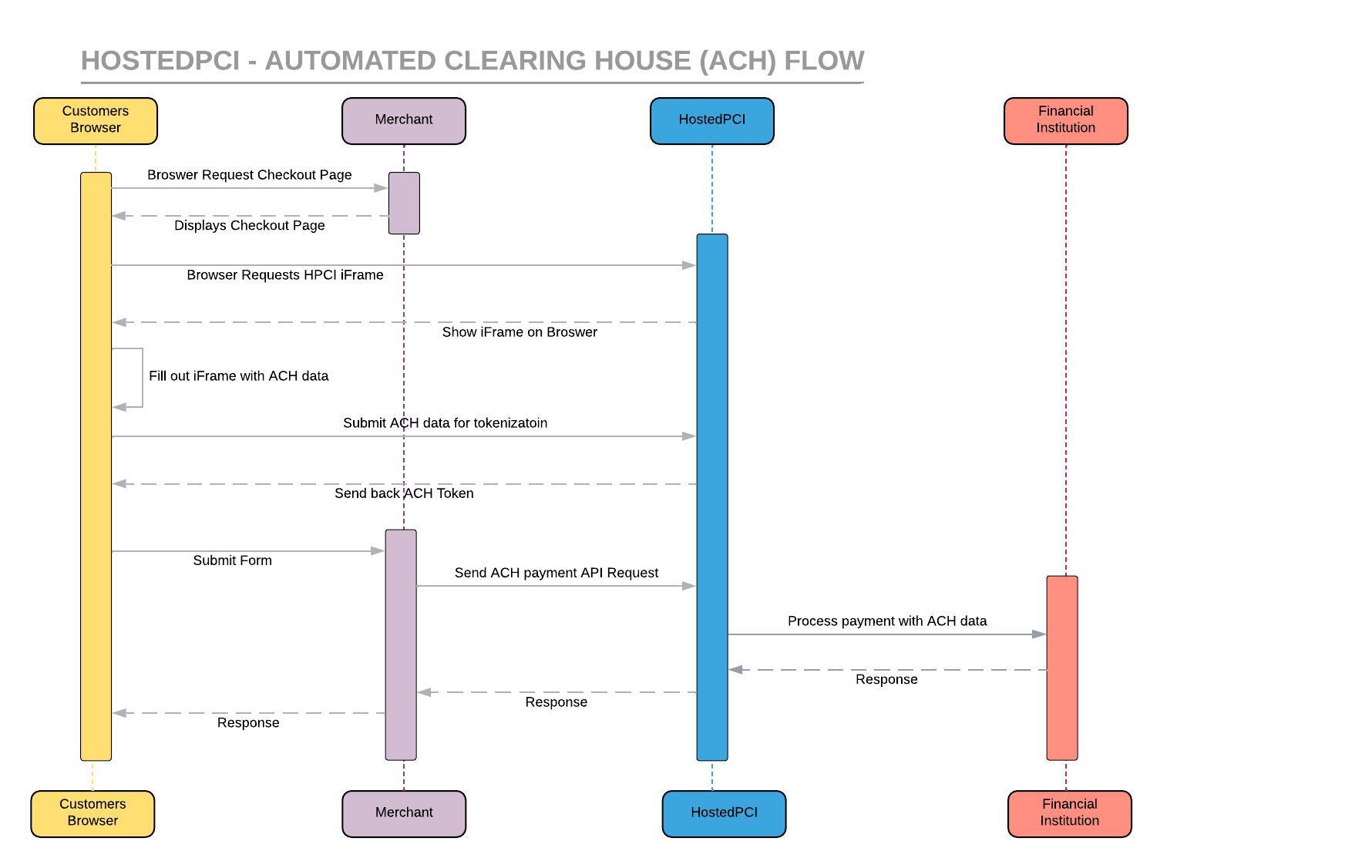
HostedPCI’s ACH solution combines hosted data collection, tokenization, and payment API integration.
1. Collect Bank Account Information
The customer enters their bank account and routing numbers through a HostedPCI-hosted ACH-enabled iFrame embedded within the merchant’s checkout page or application.
The bank account information is submitted directly to HostedPCI for tokenization.
2. Generate an ACH Token
HostedPCI receives the account details and generates a token associated with the original information.
The token is returned to the merchant’s application, allowing the merchant to continue the payment workflow without storing the raw bank account number.
3. Submit the ACH Payment Request
When the merchant is ready to initiate an ACH payment, the application sends the appropriate HostedPCI token and transaction details through the HostedPCI Payment API.
4. Detokenize and Forward the Payment Data
HostedPCI resolves the token within its protected environment and forwards the required bank account information to the configured payment destination for processing.
The original account information is not returned to the merchant application as part of this token-based payment flow.
View ACH Integration Documentation
Key Features of HostedPCI ACH Tokenization
Bank Account Tokenization and Storage
Replace bank account numbers with HostedPCI tokens while keeping the original account information within HostedPCI’s protected environment.
Merchant applications can reference the tokens without retaining the original account numbers.
Secure ACH-Enabled iFrame
Collect bank account and routing information through HostedPCI-hosted payment fields embedded within your existing website.
Customers can enter their bank account information without leaving your checkout experience.
Controlled Detokenization
When a merchant submits an ACH payment request, HostedPCI resolves the associated token within its environment.
The original bank account information is forwarded for payment processing without requiring the merchant to handle the raw account number again.
ACH Payment API Integration
Use HostedPCI’s Payment API to submit supported ACH transactions using tokenized bank account information.
The integration allows businesses to incorporate ACH tokenization into their existing payment applications and processes.
Integration With Existing Payment Systems
HostedPCI’s token-based approach supports integration with existing merchant applications and configured payment processing connections.
Businesses can maintain their customer-facing payment experience while separating sensitive account information from their internal systems.
Why Businesses Use ACH Tokenization
Reduce Exposure to Sensitive Bank Account Information
Using tokens instead of raw account numbers helps limit the sensitive financial information stored in merchant applications and databases.
Protect Account Data During Payment Workflows
HostedPCI performs detokenization within its protected environment, allowing payment information to be forwarded for processing without exposing original account numbers to the merchant application.
Maintain Existing Payment Processes
Merchants can integrate token-based ACH processing into their existing payment workflows rather than designing applications to store and handle original bank account numbers.
Support Business Growth
HostedPCI’s payment infrastructure provides a tokenization approach that can be incorporated into different applications and supported ACH payment workflows as business requirements evolve.
ACH Tokenization for Business Applications
Online ACH Payments
Support bank account payments for invoices, account balances, and other eligible electronic payment transactions.
Customer Payment Portals
Allow customers to provide bank account details through HostedPCI-hosted fields while keeping raw account numbers outside the merchant’s application servers.
Enterprise Payment Applications
Integrate token-based ACH collection and payment submission into applications that need to handle bank account information without maintaining raw account numbers internally.
Repeat Payment Workflows
Reference existing ACH tokens for subsequent supported payment requests without requiring the merchant application to store or access the original account number.
Any additional payment authorization and transaction requirements remain subject to the applicable payment arrangements.
ACH Tokenization and Data Security
Protecting bank account information is an important consideration for businesses that collect and process electronic bank payments.
HostedPCI’s ACH tokenization solution helps reduce the exposure of account numbers by replacing them with tokens and performing detokenization within its protected environment.
Tokenization can also help businesses support applicable Nacha requirements for protecting stored bank account numbers.
HostedPCI’s payment infrastructure is validated to PCI DSS Level 1 standards for applicable cardholder data services. ACH transactions are subject to separate payment network requirements, and tokenization alone does not establish compliance with every applicable ACH rule.
Frequently Asked Questions
What is ACH tokenization?
ACH tokenization replaces bank account numbers with unique tokens that represent the original account information. These tokens can be used within supported ACH payment workflows without requiring merchants to store raw bank account numbers.
How does HostedPCI protect bank account information?
HostedPCI collects and maintains bank account information within its protected payment infrastructure and returns tokens that merchants can use when submitting supported payment requests.
How does ACH detokenization work?
When a merchant sends an ACH payment request containing a HostedPCI token, HostedPCI resolves that token within its environment and forwards the corresponding bank account information for processing.
The merchant does not need to retrieve the original account number for that transaction.
Can HostedPCI collect bank account information through an iFrame?
Yes. HostedPCI supports an ACH-enabled iFrame that allows customers to enter bank account information through HostedPCI-hosted fields embedded within a merchant’s website or application.
Does HostedPCI support ACH payment processing?
HostedPCI supports ACH payment requests through compatible integrations. Merchants submit tokens and transaction details through HostedPCI’s Payment API, and the required account information is forwarded to the configured payment destination for processing.
Can merchants use ACH tokens for future transactions?
HostedPCI tokens can be referenced in subsequent supported payment workflows. Specific transaction capabilities depend on the applicable integration and payment arrangements.
What is the difference between ACH tokenization and credit card tokenization?
Both solutions replace sensitive payment information with tokens.
Credit card tokenization protects payment card numbers, while ACH tokenization protects bank account numbers used in electronic bank payments.
HostedPCI provides tokenization infrastructure for both payment types through their respective supported integrations.
Does ACH tokenization help protect against data breaches?
ACH tokenization can reduce the exposure of raw account numbers within merchant environments. If merchant-held tokens are compromised, they do not directly reveal the original account numbers.
However, tokenization should be used alongside appropriate access controls and other security measures.
Protect Your ACH Payment Data With HostedPCI
Reduce the need to store sensitive bank account numbers within your applications while maintaining support for ACH payment processing.
HostedPCI combines bank account tokenization, protected data storage, controlled detokenization, and Payment API integration to help businesses handle ACH payment information more securely.
Contact HostedPCI to learn how ACH tokenization can support your payment infrastructure.